Must Read News

Here’s the part of the Thanksgiving story most of us never learned in school. By the time the Pilgrims boarded the Mayflower in 1620, they already had religious freedom. They’d had it for about a decade, in the Dutch city of Leiden.
So why risk the Atlantic in a leaky ship with their children aboard? The answer, in their own governor’s words, says a lot about what they thought freedom was for.
This story builds on Nicole Russell’s USA TODAY column, “I’m thankful for the religious freedom we take for granted” (Nov. 27, 2025). Her argument is worth reading in full.
The argument
Nicole Russell, an opinion columnist at USA TODAY, wrote last Thanksgiving that the holiday is about more than turkey and football. Her point: we can give thanks freely because a small group of English believers risked everything to worship as they chose, and that idea later found its way into the Bill of Rights. She also warns that these freedoms aren’t the norm worldwide, pointing to arrests over social media posts in Britain and the jailing of Christians in China.
The facts back up the core of her story. The Mayflower carried 102 passengers. They arrived in November 1620, at the start of a New England winter, and roughly half of them were dead by spring (History.com).

What most coverage missed
The Pilgrims didn’t leave England for America. They left England for Holland in 1608, settled in Leiden the next year, and lived there for about eleven years. There they could worship freely. History.com, quoting their governor William Bradford, notes they enjoyed “much peace and liberty” in Leiden.
What they didn’t have was a future. They were former farmers working long hours in Leiden’s textile trade, and they were poor. Bradford wrote that the hardship was so bad that some people who shared their faith preferred prison in England to “liberty in Holland.” He also worried that their children were being pulled into the city’s temptations and drifting away from the community (History.com).
So the Mayflower wasn’t only a flight to religious freedom. It was a bet that a free people needed more than permission to pray. They needed land of their own, work that paid, and a place to raise their kids in their own faith and their own way.
The feast, in an eyewitness’s words
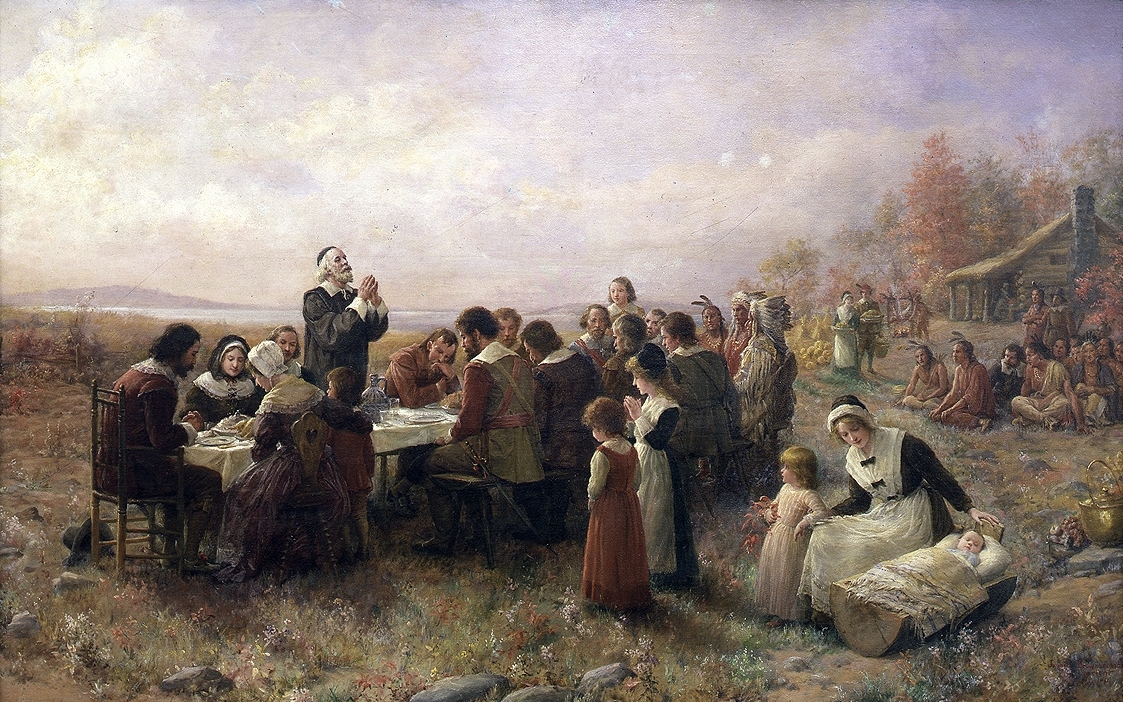
Only one eyewitness account of the 1621 harvest celebration survives. It comes from Edward Winslow, in a letter dated December 11, 1621 (Pilgrim Hall Museum; Plimoth Patuxet Museums). After the harvest came in, the governor sent four men out fowling. Then, Winslow wrote, many Wampanoag came, “and among the rest their greatest king Massasoit, with some ninety men, whom for three days we entertained and feasted.” The Wampanoag men went out and killed five deer and brought them back to share.
Notice what that means: the “first Thanksgiving” was hosted by about 50 surviving English colonists and attended by nearly twice as many Wampanoag. It was a diplomatic event as much as a dinner.

The lesson they learned two years later
There’s one more chapter that rarely makes the holiday cards. For their first years in Plymouth, the colony farmed in common: everyone worked the land and the harvest went into a shared store. Food ran short. In 1623 Governor Bradford gave each family its own parcel to farm, sized to the family. In his own history, Of Plymouth Plantation, Bradford wrote that this “had very good success, for it made all hands very industrious,” and far more corn was planted than before (Bradford, via the University of Chicago Press).
How it became a national holiday
The Pilgrims never called their 1621 feast “Thanksgiving.” The national holiday came 242 years later, in the middle of the Civil War, when Abraham Lincoln proclaimed a national day of thanksgiving on October 3, 1863 (Lincoln’s proclamation).
Our take
Russell is right that freedom of conscience is the thread that runs from Plymouth to the First Amendment, and right that it is rarer around the world than Americans assume. The Leiden chapter adds something: the Pilgrims learned that freedom to believe doesn’t mean much without the freedom to own, earn and build. They crossed an ocean for both. On a day built around a full table, that’s worth remembering.
Happy Thanksgiving from all of us at Good Food Good Feels.
Must Read News is written by the Good Feels News desk. Every fact is checked against and linked to the original reporting. Sections marked Our take are analysis and opinion. Good Food Good Feels is not affiliated with any outlet we link to.
This story is free today. Get stories like it every day:
Stay informed. Truthfully.
The US news you need today, told straight, with the context the headlines skip. A few minutes a day. $1.99 a month.
$1.99 a month, billed monthly by Stripe. It renews automatically until you cancel. Cancel anytime online, in two clicks, from this page. You keep access through the period you paid for.
Join the Good Feels community and get a free $5 experience on us.
A friendlier internet with no algorithm and no shadowbans. Join free and claim a free $5 experience, find out what your pet actually thinks, get your quantum horoscope, and more. Invite a friend and you both get another. Free, forever.
Join free & claim your gift →No spam. One free experience to start, more when you invite friends.
Leave a Reply